How Much Does It Really Cost to Maintain a Private Swimming Pool in 2025?
By 2025, France will have over 3.5 million private swimming pools. Beyond the pleasure they provide, maintaining these pools involves significant costs. Let’s explore the actual expenses involved in maintaining a private swimming pool, including chemical products, energy, technical maintenance, and how to control these costs during inflationary times.
Chemical Maintenance Costs for Swimming Pools
Proper water treatment is essential for keeping your pool clean and safe. Here are the average annual costs of essential chemical products:
Average Cost of Chlorine Treatment
Around 80% of pool owners use chlorine as their primary disinfectant. For a standard pool (8x4 meters, approximately 50m³), expect an annual budget ranging between €200 and €500. Here’s how these costs typically break down:
- Slow-release chlorine tablets: approximately €85/year
- Shock treatment (chlorine shock): around €20/year
- Alkalinity correctors and pH regulators: around €70/year
- pH+ or pH- products: approximately €20/year
- Algaecide and flocculant: about €20 to €30/year
These costs may slightly vary based on your water quality, pool usage, and weather conditions. For updated prices, refer to specialists like Desjoyaux or Guide-Piscine.
Alternative Treatments: Bromine and Salt Electrolysis
If considering alternative pool treatments, here’s what you should know:
- Bromine Treatment: Gentler than chlorine, slightly more expensive. Average annual cost: €260. Requires a brominator (~€150, lifespan ~10 years).
- Salt Electrolysis Treatment: Economical on products (~€150/year for salt, flocculants, and pH adjusters). However, involves significant upfront investment (salt chlorinator ~€1,500, electrodes ~€500, lifespan 4-5 years).
For detailed information about salt pool treatments, read the complete article on Guide Piscine.
Additional Consumables and Accessories
Beyond primary chemicals, you should also budget for:
- Filter media: sand (~€100 every 5 years), filter cartridges (~€50 to €100/year).
- Water testing kits: a few tens of euros annually.
These expenses are modest yet recurrent. Planning for them prevents unexpected costs.
Energy Costs: Pool Filtration and Heating
Energy Consumption for Pool Filtration
Filtration is essential, accounting for about 80% of water quality management. A standard pool pump (0.5 to 1 kW) running 8 to 12 hours daily during the season consumes around 1,238 kWh annually. With electricity prices in 2025 (~€0.25/kWh), budget approximately €300 annually for filtration alone.
Reduce these expenses by adopting a variable-speed pump. Learn more about energy-saving methods with the French Federation of Swimming Pool Professionals (FPP).
Energy Costs for Pool Heating
Heating significantly increases your pool’s energy bills:
- Heat Pump (PAC): Cost-effective, around €200/year.
- Electric Heater: Expensive, approximately €700/year.
- Heat Exchanger (connected to your boiler): about €400/year.
- Solar Heating: Almost free once installed, ideal long-term solution.
Optimize your pool heating by visiting the dedicated site Guide-Piscine.fr.
Technical Costs: Maintenance, Routine Care, and Repairs
Beyond chemical and energy expenses, technical maintenance forms an essential part of your annual pool budget in 2025. Here’s what to budget for these expenses.
Regular Pool Maintenance
Consistent maintenance prevents expensive long-term problems:
- Manual Cleaning: Skimmer nets, manual vacuum, and brushes (modest initial investment).
- Pool Robot: Practical and efficient, priced between €500 and €1,500 depending on the model. Typically amortized over about 5 years (annual cost: ~€100 to €300).
Regular cleaning prevents excessive use of chemical treatments and expensive interventions.
Costs Related to Winterizing and Opening Your Pool
Proper winterization protects your pool during colder months. Typical expenses include:
- DIY Winterization: Specific products and accessories (~€30 to €60 annually).
- Professional Service: Approximately €150 to €200 per service (winterizing or reopening), totaling about €300 to €400 per year.
For expert advice on pool winterization, see practical tips at flipr.shop.
Annual Maintenance Contracts
Maintenance contracts are convenient but more costly and ideal for those who prefer outsourcing pool maintenance:
- Basic Contract: Approximately €1,000 per year (several annual visits).
- Premium Contract: Up to €2,500 annually (regular visits, extensive services).
These prices generally do not include chemical costs. Compare offers from specialized companies on websites like Guide-Piscine.fr.
Repairs and Replacement Parts
Set aside a precautionary budget for occasional equipment replacements:
- Filtration Pump: €300 to €800 every 8-12 years (average annual cost ~€40 to €80).
- Filter Media (sand or cartridge): Tens of euros annually.
- Liner Replacement: Typically every 10-15 years at about €5,000 (annual provision ~€300 to €500).
- Spare Parts (chlorinator, pool robot, heater): Varies depending on equipment (~€50 to €150 annually).
For quality spare parts at affordable prices, visit suppliers like Piscine Clic.
Ancillary Costs: Water, Insurance, and Local Taxes
Owning a pool also involves additional recurring expenses you should anticipate:
Annual Water Costs for Your Pool
Annually, about a quarter of your pool’s water volume needs replacing due to evaporation, filter cleaning, and minor losses. For a standard 50m³ pool, this means roughly 12m³ of fresh water annually, translating into about €40 to €50 per year.
Learn more about saving water in pools through expert advice on Actu Environnement.
Insurance and Local Pool-Related Taxes
- Pool Insurance: Liability insurance as an add-on to your home insurance (~€80/year).
- Local Taxes (property or housing taxes): An inground pool typically raises your property tax by 5% to 10%, around €80 extra per year.
Check with your insurer and local municipality to accurately anticipate these expenses.
Total Annual Budget for a Private Swimming Pool in 2025
Summarizing the annual costs for a standard pool (8x4 meters, chlorine treatment, unheated):
- Chemical products: €180 to €230/year
- Energy (filtration only): ~€250 to €300/year
- Water (refill and replacement): €40 to €50/year
- Technical maintenance (self-managed with basic equipment): ~€100/year
- Insurance and taxes: ~€160/year
Total annual average cost in 2025: around €700 to €800. This budget significantly increases if heating or professional maintenance contracts are added.
The French Federation of Pool Professionals (FPP) had estimated these costs around €40/month back in 2021. However, inflation and energy price hikes have significantly increased costs since then. You can find updated figures at French Federation of Swimming Pool Professionals.
How Pool Maintenance Costs Have Changed from 2020 to 2025
Since 2020, the cost of pool maintenance has risen noticeably due to various factors:
- Electricity: Increased by more than 60%, from €0.15 to €0.25/kWh between 2020 and 2025.
- Chemical products: Sharp increase due to shortages (chlorine prices rose by up to 50%).
- Equipment and Spare Parts: Costs rose by 10%-20% because of increasing prices for raw materials and electronic components.
It is essential to adopt solutions that optimize maintenance costs, including efficient equipment and smart systems such as Flipr AnalysR, to better manage your pool budget.
How to Effectively Reduce Your Pool Maintenance Costs in 2025
Despite rising inflation, you can still keep your swimming pool maintenance costs under control by adopting good practices and leveraging new technologies. Here are practical and effective solutions.
Cover Your Pool to Minimize Losses
Using a pool cover or automatic shutter significantly reduces maintenance costs by:
- Decreasing chemical usage: fewer impurities and debris enter the water.
- Saving water: notably reduces evaporation.
- Lowering heating costs: retains heat and reduces energy needs.
Learn about the advantages of efficient pool covers with specialists like Abrisud.
Regularly Monitor Your Pool’s Water Balance
Frequent checks of your pool water prevent costly emergency treatments:
- Test weekly: Check pH, sanitizer levels, and alkalinity (TAC).
- Quickly correct imbalances to avoid costly shock treatments.
For accurate water monitoring, use traditional testing kits or connected analyzers like Flipr AnalysR, providing real-time tracking and optimization.
Optimize Your Pool’s Filtration System
Reduce energy costs by optimizing filtration:
- Use a variable-speed pump: saves up to 50% on electricity.
- Filter during off-peak hours: take advantage of lower electricity rates.
- Maintain filtration equipment regularly (clean filters, empty prefilter baskets) to ensure maximum efficiency.
Find your ideal variable-speed pump using the buying guide at Piscine Center.
Use Smart Technology for Optimized Pool Management
Connected devices significantly reduce maintenance costs by optimizing management:
- Smart water analyzers: Devices like Flipr AnalysR provide real-time water analysis, optimizing chemical use and filtration based on weather conditions, delivering up to 30% annual savings.
- Automatic treatment regulation: automatic pH and chlorine regulation prevents costly overdosing.
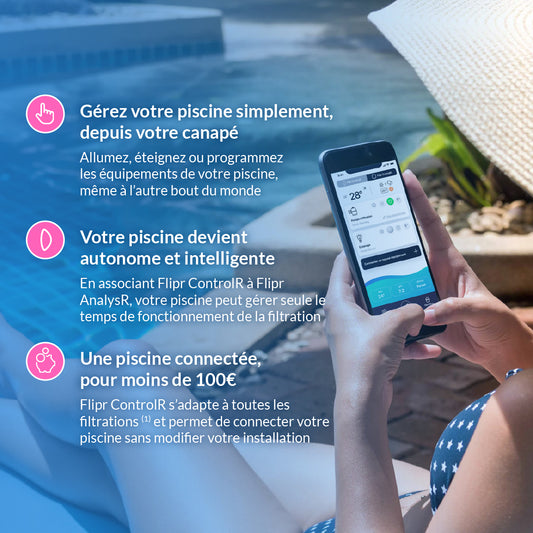
- Pool automation (domotics): automate equipment management remotely via smartphone for optimal efficiency.
Explore connected, cost-saving solutions on Flipr Shop.
Prioritize Durable and Cost-Efficient Equipment
Investing in durable, high-performance pool equipment saves money in the long term:
- LED lighting: significantly reduces pool lighting electricity costs.
- Heat pump or solar heating: more economical than traditional electric heaters.
- Hydraulic pool robots: cost-effective and energy-efficient as they do not require additional electricity.
Find top-quality sustainable equipment solutions at Guide-Piscine.fr.
Ensure High-Quality Winterization
Careful winterizing protects your pool and reduces startup costs:
- Treat the water properly before winterizing to prevent algae growth.
- Install anti-freeze accessories (plugs, floats, gizzmos).
- Set filtration to minimal operation during cold months to reduce your electricity bill.
For more detailed winterizing advice, see the complete guide at Desjoyaux.fr.
Conclusion: Effectively Managing Your Pool Budget in 2025
In 2025, maintaining a private swimming pool typically requires an annual budget between €600 and €800. Nevertheless, adopting good practices and smart technologies (like Flipr AnalysR) helps you manage and even significantly reduce these costs, despite inflation.
Embracing these strategies allows you to fully enjoy your swimming pool while effectively managing your annual expenses. The initial investment in high-quality, connected equipment quickly pays off in terms of both economic savings and enhanced ease of use.
Don’t hesitate to explore these solutions to make your pool a sustainable and enjoyable investment for years to come.